Sunday, September 12, 2010

Couchsurfing & sight seeing in Hong Kong


It’s amazing to see all the different types of people, from different walks of life, that you meet when you are traveling. Staying at Sean’s tiny apartment on the outskirts of Hong Kong, with his mother, two brothers and lots of other couchsurfers, it really was like staying at a busy hostel. For a few days you cross paths with very different people from all over the world and connect through the one thing you have in common: a passion for travel (for those of you that aren’t familiar with couchsurfing, check out their website).
Out to dinner with Sean's couchsurfers. More pictures from Hong Kong here.
For the first few days of my stay, Sean was also hosting an Australian man, three German men, and a girl from the Netherlands. In his tiny apartment, that meant 2 people in a full-size bed, one on a cot, and two on the floor. So for the first two nights I slept on a yoga mat. But it was better than that hard seat on the train ride, and Sean’s family was quite generous, cooking me a few meals, helping me to wash cloths, and allowing me to stay for nine days. Through couch surfing I also met up with another women from Hong Kong named Margot, a very friendly, lively character who is conversant in several languages and is thinking about starting a business to bring street art into mass the main stream through a unique marketing campaign. She also offered to introduced me to several people she knows in Shanghai so that I have some people to meet when I get there.

A few days after I arrived, one the Germans, Marko, and I took a day trip to Lantau Island, Hong Kong’s second biggest island. Lantau is probably the least developed of Hong Kong’s Islands, aside from the airport. We first took a cable car that brought us from the train station half way across the island, up over the tops of some 2,000+ foot tall mountains, to end at the world’s largest statue of the Budda. This thing must have been over 100 feet tall and sits up on a cliff overlooking the ocean and nearby islands. After seeing the Budda, we traveled by bus down into a small fishing village, one of the few areas that has been minimally impacted by Hong Kong’s rapid development. We went for a boat ride through the village and then out into the open ocean where we saw dozens of large trade ships coming into dock at Hong Kong’s port. As we zoomed across the water, I was momentarily brought back to zooming across lake Annecy in a sporty little sailboat. Finally, as we rode the bus back around the island to the train station, Marko and I saw some beaches and stopped for a quick look that turned into three hours of hanging out on the beach and eating dinner in a little café on the beach’s edge. When I decided to go for a swim, I discovered that the water was a warm as a heated pool. “I could get used to living in Hong Kong,” I thought to myself. Unfortunately virtually no one in Hong Kong speaks Mandarin as a first language. I’d be hard pressed to perfect my Chinese here.
A refreshing, cold beer on the beach...no I was not paid by Carlsberg to include this.  
See more pictures of Lantau Island here.

I also was beginning to realize that Hong Kong has a lot of opportunity, but not much in the way of clean energy (at least not that I could find in a week). This was confirmed when I met with two Tufts alumni to get some career searching advice. Michael Fung, the Chairman of JP Morgan Asia, has an office on the 29th floor of a building in the heart of Hong Kong’s financial center. After meeting him in France this summer (the Tufts Board of Overseers had their annual meeting at the European Center in Talloires), he agreed to meet with me to give me some career advice when I arrived in Hong Kong. He said if I wanted to work in clean energy, and practice mandarin at the same time, I should go to Shanghai or Beijing. He also gave me some helpful advice on networking and presenting myself, commenting on how I was dressed that day (I scored pretty high marks except for not having a blazer), and how I could make myself memorable to people. The whole meeting was quite fast paced and formal, but went quite well overall. If I ever want to get a job in banking I might have an in…

My interaction with Tufts Overseer James Soutar on the other hand was quite different. One night he invited me to a “party” at a bar he owns in Hong Kong called “Home.” The party turned out to be a gathering of an organization called “Internations,” an organization that organizes social events for expats in hundreds of cities around the world. While James had to leave before I arrived, I met him the next day at his bar, in a very casual atmosphere. He gave me some similar advice, and especially emphasized that I should “do what I love, and the money will follow,” a mantra that I continuously try to live by. Hearing it from a successful hedge fund manager and bar owner though was quite insightful…

During one of my last days in Hong Kong I met up with my friend from Dan Resnick, a current graduate student at the Tufts Fletcher School. Dan was traveling through China with his girlfriend after doing an internship with the Clinton Global Initiative for two months in Swaziland. We spent most of the day walking around in Hong Kong’s various outdoor markets, taking a ferry across the Pearl River, and eating a delicious seafood dinner of crab and lobster (Though Dan thinks all lobster tastes the same, I insisted that Maine lobster is the world’s best).

And finally, I am off to Shanghai to continue my job search and see China’s current pride and joy, the Shanghai World Expo…

Wednesday, September 1, 2010

The Asian Century?

Today (August 29th) I accompanied my friend Jenna and her family to Church, located on the 79th story of one of the tallest buildings in Hong Kong. This was not the traditional church that I grew up with (and even less like the church that many of you grew up with). There was no alter, no pews – in fact nothing that resembled a church in the slightest. The pastor wore a suit and tie rather than a robe (although he was a 66 year old American – the one thing that made this believable) and stood at a transparent lectern. Behind him was a band that played and sang modern Christian songs rather than psalms, and a wide screen TV displaying the lyrics and passages from the scripture. The mass consisted of singing songs and the pastor’s sermon. There was no parading in, no alter boys, no communion, and no rituals. And I thought my church back in Freeport was progressive. This brought a whole new meaning to contemporary Christianity.

Anyway, after the mass was finished, I met another young American named Nick who had moved to Hong Kong a year ago to start a new life. We began talking and it turned out we are both interested in a lot of the same things – China, business, international affairs. Then he made a startling confession. He said he wasn’t planning to return to the US. “There’s no more opportunity in the US,” he said. “All the opportunity is here, in Asia.”

Looking out the window of the 79th story of one of the tallest buildings in Hong Kong, at the surrounding skyscrapers, trade ships, cranes and construction sites, at first it was hard to disagree with him.
View from Jenna's church
But his comment disturbed me, and for a while I couldn’t stop thinking about it. No more opportunity in the US? The US has always been the land of opportunity. For over 200 years it has welcomed immigrants from around the world seeking a better life, with more opportunities and freedoms than any other country. But other questions continued to plague me. Is the US political system and the US treasury, just like the investment banking sector, going bankrupt, as so many people are beginning to believe? The 20th century was the American Century, as Henry Luce stated in 1941, but these days everyone is talking about “the Asian Century.” China has grown at three times the pace of the US for the last 30 years, and some of its neighbors (i.e. Singapore, South Korea) have grown even faster.  An increasing number of young westerners looking to seek their fortune, like Nick and myself, are going to Asia where business is booming.

And as many of you may suspect, I have been thinking a lot recently about whether I could see myself permanently moving to Asia. And now I realize what really disturbed me about Nick’s comment: I used to think I would only move to Asia for a few years and then return to the US, but lately I have become increasingly uncertain. There's so much opportunity here that its tempting to consider staying.

Part of the reason I’m going to China is for the disorderliness, for the chaos, the discomfort, and the conflict – because it will be an adventure and because there is an almost endless number of problems to be solved there (check out this really cool video made by a friend of mine that does a better job at describing these issues than I ever could). But there are also plenty to be solved in the US – and plenty of conflict and chaos there as well. And I don’t believe that there is no longer any opportunity in the US. As long as American’s continue to hold their government truly accountable, and don’t let apathy and ignorance take hold, America will continue to be a dynamic, prosperous society. And above all, there is one thing that the US will most likely continue to have in the next century that Asian countries may not have: innovation and creativity – because unlike Asian societies, American society rewards and encourages initiative and independence. The rise of Asia presents a healthy new challenge of the US, and as long as we don’t give up on our core values, I think Americans will rise to the challenge.

But as this contemporary church at the top of a skyscraper demonstrates, Americans also need to make sure we don’t get stuck in our old ways, that we are aware of what is going on in the greater world, and that we continue to move forward, adapting to the changing world around us.

I think for now I’m still set on returning to the US after a few years. China is an adventure that will help me to see the larger world and bring some of the insights I gain back to the US, where we need it now more than ever. Asian Century or not, I still believe in the American system – it just needs some work. 

Returning to Hong Kong, August 22nd – 25th

I woke up Sunday morning in Lijiang to a wonderful sound: silence. For a minute the blue, semi-transparent curtains of my room tricked me into thinking the sky outside had turned blue, but when I pulled them back, the sky was just as foggy and gray as ever. Still, it wasn’t raining…yet. So I decided to suck it up and go hiking in the nearby mountains as I had planned. I set out around 8:30am on what was suppose to be a six-hour hike (round trip) to find a village in the mountains near a lake called Wenhai.

No sooner had I left Yuhu village then the rain began again. I was wearing all quick-drying athletic cloths, but in the interest of packing light, I had left my rain jacket in Hong Kong (real smart during the rainy season, I know…) and was only wearing a semi-water proof running jacket. I took shelter under a pine tree for about 20 minutes until the rain lightened up and then trekked on. The rain continued off and on all morning, and I continued to find shelter under trees and ledges. As I continued into the mountains, the trail began to diverge into several different paths. I had been given rough instructions on how to get to the lake (stay on the main trail, heading Southwest, and when you pass a dam you know you’re almost there), but it was getting increasingly difficult to tell which trail was the main trail, and on several occasions I found myself on the wrong trail and had to back track. It has already been two hours and I didn’t feel like I was getting anywhere.
One of my hiding places from the rain 
I began to hear a stream or river running in the distances. Was I supposed to cross a river? There was no indication of this on the very touristy-looking, imprecise map I had been given. As I crouched under yet another ledge in the middle of the forest, about ready to give up and go back, I began to hear voices shouting near the river. Even though it was still poring, I began running down the trail, hoping I would come across someone who could tell me which way to go. As I emerged from the trees at the edge of the stream, the rain began to stop and on the opposite bank I saw a group of men leading a family traveling on horseback. I crossed the stream and asked the men how to get to Wenhai. They told me they were heading in that direction and that I should follow them.

These men were local Naxi who had made a business out of leading tours on horseback of the valley and mountains surrounding Yuhu (I’d seen their office in the village earlier), and the family that they were leading had come from Kunming. As does every Chinese person I meet, they asked me what I was doing in China and where I had learned Chinese (I’ve gotten pretty good at answer these questions by now). Most of them were from other Naxi villages nearby. They walked this trail almost every day, which was evident by the horse tracks and droppings in the mud, and by how well they knew the trail. Every so often they would pick berries and nuts off the trees and give me some to eat. I’d normally never eat strange berries and nuts in an unfamiliar wilderness, but these men were native to the land and seemed to know it very well. When they stopped for lunch they also offered me a bun with meat and vegetables, which I gladly took since I realized I hadn’t brought enough food. Finally we reached the top of a pass between the mountains and the dam that was shown on my map came into view. The men pointed me along a road that circumvented the lake and disappeared off into the fog. “It’s about another 30 minute walk to Wenhai from here,” one of them told me.

Sure enough, after about a half hour of following a windy dirty road through another mountain pass, I spotted Wenhai lake down below me. I descended to the village, which was even more remote and ancient looking than Yuhu. There were horses grazing and farmers working in rice patties in the lush plane at the lake’s northern end. Aside from a few cars and electric wires, there was no evidence of modern civilization anywhere. It was already 3:00pm so I didn’t spend long in the village, but began following the road back to Yuhu. Suddenly as I came around a bend I was greeted by a startled pack of wild horses, who half trotted, half galloped off the trail. Still, I was able to get pretty close and take some good pictures.
Dam at the top of the mountain pass
Wenhai village - view other pictures from the hike here.
When I finally returned to Yuhu, the guesthouse was bustling with activity. It turned out it was Javad’s niece’s birthday, and his wife’s whole extended family had come over for dinner. Javad’s sister in law also had some friends visiting from Japan, and there were two more Americans who had come to stay at the guesthouse. As I was talking with one of the Americans named Conrad, he mentioned that he was currently at graduate school in Geneva. “Oh, I just spent the last two months not far from there, in Talloires, France,” I said. “I just graduated from a University called Tufts…have you heard of it?” “I just graduate from Tufts a few years ago.” Conrad said.  What a small world.

I was starving from my hike, and wolfed down my food as I listened to people speaking Japanese, Naxi, Mandarin and English around the table. I also talked with Javad’s brother in law, who was originally from Chengdu and was quite an avid mountain climber. He told me that he had climbed the Jade Dragon Snow Mountain, a 4,000 meter (12,000 foot) mountain that boarders Tiger Leaping Gorge. It’s one of the largest mountains in the region and also is the most southern, glacier-covered mountain in the region. He told me that if I returned to Lijiang again he would guide me up the mountain. After dinner we had a birthday cake for the little girl, who had just turned nine, and who insisted that we all perform something for each other (she was really taking advantage of being the only kid among 15 or so adults). For my performance I told the story (in Mandarin and English) of how I got “married” to one of my classmates in a role-play of a traditional wedding ceremony in Lishui, China. I’m not sure if the story made sense to the Japanese speakers (who spoke very little English and Mandarin), but it was fun and confidence building to know that I could tell this story in Chinese.

After wondering why I had come to Lijiang the night before, this day had turned out to be quite an adventure. I may not have found Shangri La, but I did find a small, tranquil Chinese village in the mountains, and meet some really interesting people. And in the end, that’s what really counts.

The next morning I began the long journey back to Hong Kong. This time I took a train rather than a bus from Lijiang back to Kunming. Once again I was squished into a series of seats crowded around a table with five Chinese people. It turned out that these people were all traveling together and had never met a foreigner before. I spent a good part of 10 hours answering their questions and talking about differences between China and the US. It was really interesting to see what Chinese people who are not as exposed to the international community (unlike a lot of the Chinese people I’ve met in the past) think about Americans and the US. We even talked about the war in Iraq and the US Presidential elections.

When I arrived in Kunming it was late at night, and I immediately headed for the ticket window to buy a ticket back to Guangzhou before going to my hostel for the night. I first went to the ATM to withdraw some money, and noticed a homeless man sitting outside the door to the ATM room. There are so many of these types of people around the streets of China’s cities that I did what I usually do and ignored him. Fifteen minutes later I opened my wallet at the ticket counter to pay for my ticket, and noticed that my ATM card was missing. I suddenly realized I’d left the card in the ATM! Cursing myself (I’ve done this before in a foreign country) I ran back to the ATM, vainly searching to see if I’d dropped it on the ground or by some miracle someone had taken it out and left it near the machine. When I arrive at the ATM the homeless man suddenly got up and started excitedly babbling in what I think was Mandarin, but his accent was so thick it was hard to tell. He pointed off down the plaza and I eventually realized that he was pointing to a police car. I ran over to the car and asked the police if they had found an ATM card. They thought for a minute, and then one of them reached into his pocket and pulled out my card! Thanking them I ran back to the homeless man, preparing to give him a 10 or 20 kuai note so he could go buy some food. But when I got there he refused my money. “If you want to thank me, go buy me a cigarette!” is what I finally discerned from his babbling. So for the first time in my life, I went to a convenience store and bought a pack of cigarettes. I returned and handed one to the man, who nodded his approval and told me to continue on my way.

The rest of my journey back to Hong Kong was pretty uneventful. I had a bed this time on the 26-hour train ride, so I spent most of the time reading and sleeping. When I arrived in Hong Kong I retrieved my other backpacks from Jenna’s mom’s office (with quite a bit of difficulty as my phone battery had died and I didn’t have any way of getting in touch with her) and finally arrived at the home of my new host Sean, whom I’d found on couchsurfing.org, at 10pm. Sean lives in a small apartment with his mother and two brothers. On top of this however, his apartment has become couchsurfing central in Hong Kong in the last few weeks, as his endless generosity has made it difficult for him to say no to anyone (in fact me and the other couchsurfers staying there began calling his place “hostel Sean”). So the night I arrive there was also an Australian and three Germans staying at his apartment. I slept on a yoga mat on the floor. But it was an improvement from Chungking Mansions, and I was just happy to be staying in one place after a week of traveling.

Sunday, August 29, 2010

Looking for Shangri La, August 17th – 21st


What am I doing here?

This is what I started to ask myself, as I lay in bed at a Naxi guesthouse in a small village 20 kilometers from the city of Lijiang, listening to the soft pitter-patter of the rain outside. It wasn’t one of those existential, “what is the meaning of life,” questions, but the simple question of why I had come all this way, traveling more than 38 hours by train and bus, to arrive in a cloud-covered valley with little prospect of doing what I had come to do: go hiking in the mountains.

Lijiang sits in a valley near the edge of the mountain range that eventually becomes the Himalayas about 500 miles to the west. Lijiang is also a few hundred kilometers north of the capital of Yunnan province, Kunming, the “city of eternal spring.” Yunnan is a highly biologically and geographically diverse region, from glacier-covered mountains to temperate plains, to rainforest in the south. Ever since I unsuccessfully applied for a Fulbright grant a year ago to do research here on China’s solar energy development, I had been itching to travel to Yunnan. Just north of Lijiang, only a few hours by bus, sits the region that is supposedly the basis for James Hilton’s “Shangri La” in his 1933 novel Lost Horizon. Shangri La has come to be synonymous with a utopia, isolated from the modern world, were the people never grow old and everyone is always happy. I had hoped to travel there, or at least near there, to go hiking in Tiger Leaping Gorge. After two months in the beautiful French Alps, I seemed to have this idea that I was going to find another paradise in the mountains and valleys of Shangri La. It turns out my expectations for this trip however were highly unrealistic.
Lijiang Valley during the rainy season
As I prepared to leave Hong Kong only a day after I had arrived, I received multiple warnings that there was currently flooding and landslides in the west near the mountains that I wanted to travel to. “It’s the rainy season,” everyone kept saying. Still, I ignored these warnings and decided to base my expectations on the weather.com forecast that “weather in Yunnan is just as varied as it’s geography,” and hope that I would be lucky enough to hit a patch of sunny days.

In order to get to Yunnan however, I first had to find a long-distance train from the Pearl River Delta to Kunming. Perhaps the most industrialized and densely populated region in China, the Pearl River Delta is lined with the mega cities of Honk Kong, Shenzhen and Guangzhou, as well as many other cities. In order to get a train ticket to Kunming, I first had to travel three hours by subway and train up to the Guangzhou railway station (there is no way that I know of to buy train tickets remotely in China) at the northern end of the Delta. I left Hong Kong Tuesday afternoon after lugging most of my bags to my friend Jenna’s mom’s office in downtown Hong Kong, where I would be leaving all but a small backpack for my week-long journey. Between navigating my way through the transportation system, going through customs into China, and waiting in a long line at the train station, I finally reached the ticket window around 9pm. “One ticket to Kunming with a bed please,” I said in Chinese. “We don’t have any sleeper cars available until Thursday” the attendant told me. I had been told that I shouldn’t have any problem buying a train ticket for that evening or the next day, but it seemed that Kunming was a popular destination this week. Slightly surprised and annoyed, I ended up buying a non-sleeper for the following evening. Looking back now I’m not sure why I bought a non-sleeper – perhaps I was just too tired to concentrate – but this would prove an interesting choice.
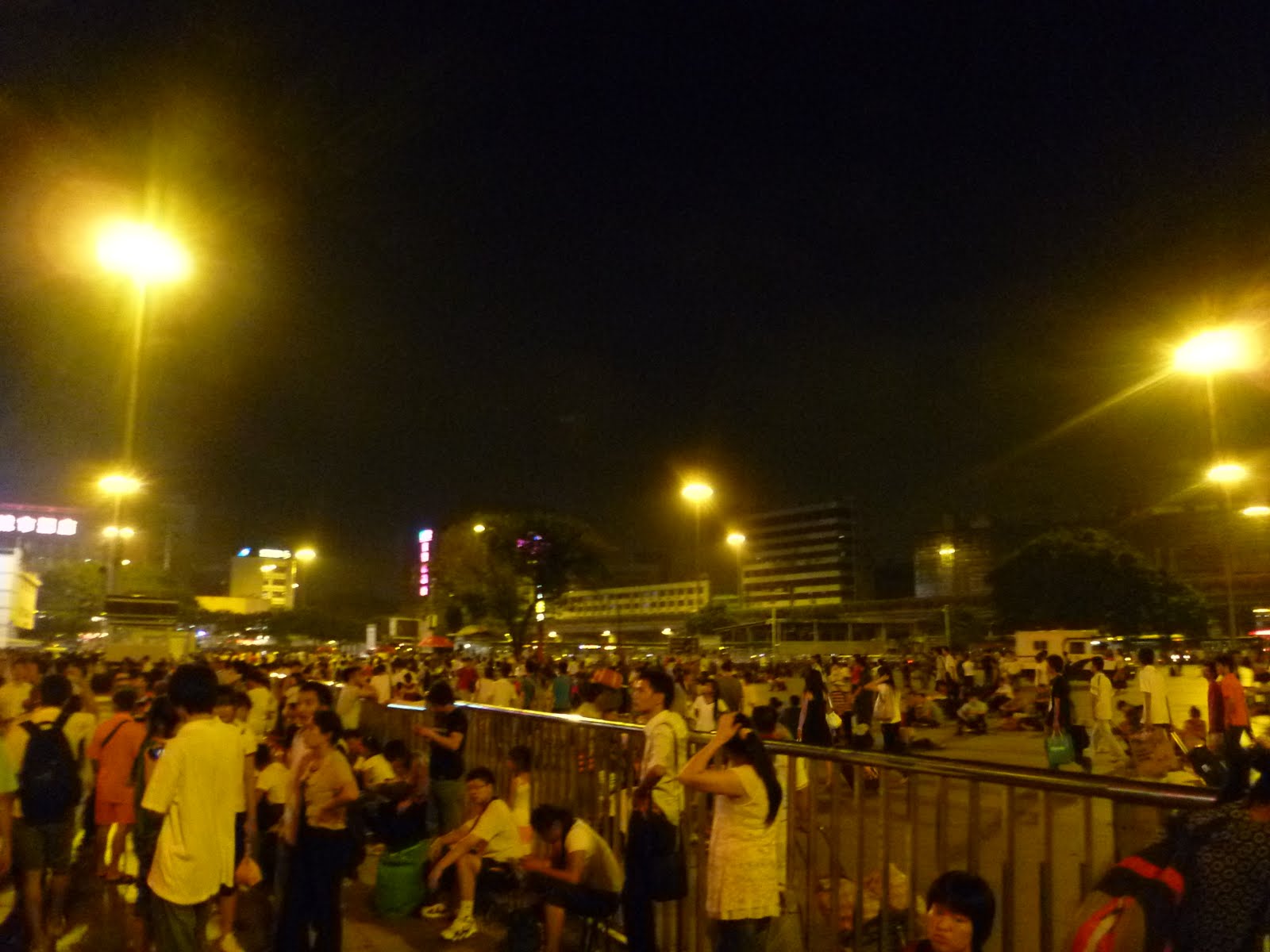
Waiting outside the crowded Guangzhou railway station to get a ticket 
After spending the night at a cheap hotel and an afternoon walking around a park in Guangzhou (I decided this is one of my least favorite cities in China), I boarded the train to find myself sitting in a hard, upright seat next to six other seats crowded around a small table. Not only was every seat filled, but there were people standing and sitting in the isles – for a 25 hour train ride! Where did they expect to sleep? I would soon find out just how resilient the Chinese can be.

As the only westerner for at least 3 train cars, I began to draw people’s attention and I soon had a cadre of Chinese people crowded around me, listening to me explain in my rusty Chinese what I was doing in China, traveling in a non-sleeper, non AC car, to Kunming. My main interrogator, A 26 year old man who had originally been standing in the aisle, squeezed himself between the three women sitting across from me, and proclaimed me his new “Waiguo pengyou” (why-gwuo pung-yo is the best pronunciation guide I can come up with), or “foreign friend.” He then ordered a 25ml bottle of bai jiu, the Chinese hard alcohol, for each of us, along with some spicy chicken legs and cow tongue. Thinking I might as well make some friends for what would otherwise be a nearly unbearable train ride, I spent the hour from 12 to 1am eating chicken legs and cow tongue to rid myself of the disgusting taste of the bai jiu, and then drinking more bai jiu to counter-act the spiciness of the food I was eating. After we had finished, my new friend invited me to smoke with him near the door connecting our train car to the next. Throughout high school I was vehemently anti-smoking. Even now I’m still generally against it and smoke very rarely, but I’ve come to realize that 1) So many other things in modern society are giving us cancer too and 2) like drinking, smoking can be a social lubricant, especially in developing countries where the social stigma against it doesn’t exist as much as in the US. In fact, so many men in China smoke that exchanging a cigarette is a form of social currency and a way of building valuable social capital in a country where foreigners are often distrusted (as I would learn on two other occasions during my trip). So I reluctantly joined my friend for three cigarettes over the course of the night. Thanks John for teaching me how to hold a cigarette correctly.
Sleeping on the train to Kunming
After we’d been talking for a while, my new friend ask me if I wanted to come back to his home city of Chengdu with him, meet his family and see the city. This struck me as pretty bold request considering we’d just met six hours ago. It sounded exciting, but it would mean another 18-20 hours of train riding once I reached Kunming, and who knew what I would find when I arrived in Chengdu. Maybe this guy wanted something from me and had been buying me drinks and calling me his friend to get me to come do… I don’t know what. I think I was just making up excuses not to deviate from my plan, as my mind was still set on hiking. I declined as politely as possible. With people sleeping in the aisles, either slumped against the seats or sitting on stools leaning over themselves, I tried to sleep in my hard, upright chair, without much success.

View from the train to Kunming
After 26 hours with very little sleep, lots of bad food and plenty of alcohol, I arrived in Kunming around 11pm, found my way to my hostel, and passed out. The next morning I began trying to figure out the best way to get to Lijiang and looked for a hostel in Lijiang for that night. In China you have to buy any train or bus tickets at the station that they leave from. This makes it quite difficult to plan ahead if you only arrive at your destination a day or two before you want to leave, because as I learned there is no guarantee you will be able to get a ticket for the time, or day that you want at that short notice. Consequently I didn’t have any trains, busses or hostels booked more than a day in advance. But as I searched for a hostel in Lijiang and everything was booked, I realized it was Friday and Lijiang must be a popular weekend destination. In desperation I got on the website couchsurfing.org and began looking for someone living in Lijiang that I could stay with, although these people often want a little more advanced notice than half a day. And that’s how I found the Nguluko Guest house in Yuhu village, 20 kilometers north of Lijiang city. I contacted the American manager, who said they would have a bed for me that night and he could even pick me up at the bus station. The price was a little more than a hostel, but it included meals.

The staff at the hostel directed me to a bus station where I could buy a bus ticket pretty short notice to Lijiang. Even though Lijiang is only about 300 kilometers away from Kunming, it took about 10 hours to get there. On the way we traveled over some pretty treacherous, twisty, pot-hole filled roads with cliffs straight up on one side and down on the other. When I arrived the American, Javad, greeted me and then drove me out of the city to the small Naxi village of Yuhu. The Naxi are one of the 55 ethnic minority groups in China. While they look Chinese to most westerners, there are subtle differences in facial features between them and the main ethnic group, the Han Chinese, which constitute the vast majority of the country’s population. It was once again late when I reached my final destination for the evening, and after a quick tour of the guesthouse I went right to sleep.
Nguluko Guest house (taken from their website)

It had been sunny in Kunming the day before, so I was hoping I would wake up the next day to a beautiful view of the mountains. Instead, the first thing I noticed as I became conscious was the steady sound of falling rain. With a slight dread growing in my stomach, I slowly got out of bed and descended to the courtyard, which I had to cross in order to get to the Kitchen for breakfast. Almost all the houses in the village are designed in a traditional Chinese style with an ornate courtyard surrounded by a two-story building on all four sides. While Javad was the business manager, the guesthouse was the home of his parents in law, two Naxi Chinese. They both dressed in very traditional clothing, spoke very little English and some Mandarin with a heavy accent.  In fact the man looked as if he had just come from the Chinese military, as he constantly wore a straightjacket and cap. They were very friendly however and cooked great food. Yuhu village itself is quite remarkable. Aside from some modern conveniences like cars, electricity and running water, the Naxi seemed to live much like they probably had for the last several hundred years. According to Javad, even though the Naxi were traditionally a nomadic tribe, they had built permanent settlements in this lush valley. Their beliefs and way of life is actually much like that of Native Americans – they are mainly animists and live close to nature. They are also one of the few cultures in the world that still uses a hieroglyphic language.
Naxi elders playing Mahjong - for more pics from Yunnan, click here.
That day I decided to go into Lijiang city and see the “old city” there, although after Yuhu this actually proved quite touristy. Still, I found a cool little Tibetan café to hang out in, drink coffee and use the Internet. As night fell, the bars of the old city began to come alive with lights, music and dancing. I thought about going to hang out in one of them, but I didn’t know anyone, and Javad’s parents in law had already cooked dinner for me. Even though it was very interesting staying in the Guesthouse, there never seemed to be anyone around except some Naxi (whose speech I couldn’t understand very well) playing mahjong. And since it was still raining too hard to go hiking, I was beginning to wonder what I was going to do here. I grabbed a cab back to Yuhu, but in the dark my cab driver got lost and had to stop several times to ask for directions. It was dark and foggy and for a while I thought we would never find the village. The third time we stopped, the driver rolled down my window to ask directions from an old man. As he did so, he passed the man a cigarette.  I have always had a hard time getting accurate directions from Chinese people (even if they don’t know, they will pretend like they do to save face), but I suddenly realized that somehow, this little gift was going to motivate this man to give us accurate directions. We eventually made it back to the Guesthouse and ate dinner and then went to sleep wondering what I was doing in Lijiang during the rainy season, with no friends and no sun. Paradise, whether it’s Talloires or Shangri La, felt especially far away…

Arrival in Hong Kong, August 16th

Note to self (& other would-be travelers): Never travel with backpacks instead of suitcases when your bags weigh 60 pounds and your backpack straps are highly uncomfortable.

Before I started on this trip I convinced myself that it would be easier to travel to unknown places (i.e. possibly on rough terrain) with back packs rather than suitcases, as traveling in India two years ago with two large suitcases proved difficult. Now I realized I’d much prefer the suitcases. I managed to pack my entire life for 2-3 years into four bags – a large backpack, a small backpack (which I wear on my front), a duffle bag in one hand and a garment bag in the other. When I have all four of them hanging off me it looks pretty ridiculous, and I drew quite a few stares as I walked through the streets of Hong Kong from the airport to my hostel. I’ll include a picture here sometime soon.

The hostel in which I spent the first night is called the Oriental Pearl, located in the Chungking Mansions, a large mall/ apartment complex in the heart of the Kowloon district, downtown Hong Kong. The same hostel is actually described by the author of the book “Undress Me in the Temple of Heaven,” a memoir about two women traveling in China in the early 1980s (for anyone whose been to China though, the book is not that good). Unlike the rest of the city, it seems like the building and the hostel haven’t changed much in 30 years, as there are still lots of sketchy characters hanging around the entrance, the elevator up to the hostel still has paper sidings on two of the walls, and the rooms are hot and cramped with broken AC systems. 
My tiny little, four person suite
The ground floor of this complex is filled with stalls selling knock-off phones, watches, shoes, cloths and everything else commonly found in China. Surprisingly there are also quite a few Indians and Africans working and living around this area, which I suspect is not characteristic of the rest of Hong Kong. Skyscrapers densely enclose the street outside with shops at their base, and bright neon signs advertising various stores and products. It looks a lot like New York, but with some distinctly Asian characteristics (i.e. signs with Chinese characters). I’ll be staying here for one night, then hopefully heading off to Yunnan tomorrow morning.

Aside from the sketchy Chungking Mansions however, what I’ve seen of the city so far is quite interesting. As I was riding the train in from the airport, we passed lots of high-rise apartments nestled into the sides of mountains. In fact I’ve never seen such tall apartments before – some of them are as tall as commercial skyscrapers that you’d expect to find in the middle of the city. Being located on a mountainous island makes land very limited though, so I guess they have to compensate somehow. This evening my friend Jenna treated our friend Siauxi and me to an all you can eat Korean BBQ (where you actually cook the meat yourself on a heated platter in the middle of your table), in the more upscale center of the city. Hong Kong even has its own Times Square, and the area again did look strikingly like downtown New York.
The street outside the Chungking Mansions

Tomorrow starts what will probably a pretty complex travel route (I have to go from Hong Kong to Shenzhen to Guangzhou to Kunming to Lijiang…) with plenty of surprises along the way. I’m going to brace myself and hope for the best.

Energy Policy & Sustainable Urban Development in Singapore


So why study these things, and why Singapore?

I think the answer to both these questions is best summarized by the theme of the Shanghai World Expo: “Better City, Better Life” (I will be visiting here next week – to learn more about it see http://en.expo2010.cn/). In 2007, for the first time in history, the majority of the world’s people lived in cities rather than in rural areas. In the next 20-30 years, it is projected that some 300 million Chinese will migrate to the countries booming cities. The story is similar in India and other large developing countries. If we are going to prevent environmental catastrophe and improve health, safety and standards of living for people around the world, the answer lies in the world’s cities.

In order to make cities more sustainable and less reliant on dirty energy, better city planning and more city-wide energy efficiency and clean energy programs are needed. Singapore, perhaps more than any other city in the world, has planned its growth carefully – mainly out of necessity – has focused above all else on improving life for its citizens, and is home to some of the most progressive urban environmental experiments. I wanted to learn more about what is being done in Singapore to see how it could be applied to Chinese cities, which in contrast often lack careful urban planning and are reap with environmental problems – in fact 7 of the 10 most polluted cities in the world are in China.

Thanks to Michael Quah at Singapore’s Energy Studies Institute, I learned a lot about Singapore’s energy policies and was able to meet with a key decision maker at the National Environment Agency. While in Singapore I also observed first hand the implementation and effectiveness of some of the cities environmental programs.  

At the Energy Studies Institute with Michael and another researcher Valerie. Looking awkward for yet another research picture...
My meeting with Michael above all got me thinking about energy and sustainability policy in the context of different political systems. And while I believe strongly in the American political system – based above all on liberty and equal opportunity – Singapore’s success does raise some doubts about the ability of the American system to address long-term problems. Energy policy and planning in the US is plagued with subsidies, the influence of special interest groups (whether it be the energy companies themselves, environmental groups or others), and elected officials who often don’t think beyond the next election cycle.  This makes something like energy policy, which requires long-term goal setting and system-wide thinking (i.e. considering how various aspects of our society interact with each other and how they are related to energy policy, such as transportation systems, electric power systems, trade policy, social welfare, economic growth, environmental problems, food production, urban planning, etc.) very difficult.

As Michael pointed out however (Michael is an American, originally from Michigan) Singapore has virtually none of the political problems that America, and even China, have. Because it is a small city-state, run by one party that does not have to spend millions of dollars to run for re-election, there is very little influence of special interests on energy policy planning. This leaves Singapore’s leaders (who I might add almost all have PhDs) to rely on the people who they should be listening to: scientists, economists and professional urban planners, who study the trade-offs to different energy policies from a fairly pragmatic and unbiased perspective. Case in point: Singapore may be one of the only countries in the world that does not subsidize it’s energy industry – at all. I know for those of you who don’t study energy policy it’s hard to understand the significance of this, but it’s actually quite amazing. This means that gas prices are not artificially depressed to encourage car ownership – in fact car ownership is generally discourage in Singapore (although there are still a lot of cars). It also means that people pay high prices for electricity, so they tend to conserve that as well. At the same time however, it means that renewable energies also are not subsidized, making them currently uncompetitive in Singapore.

What Michael told me then is that Singapore wants to act as a laboratory – a testing ground for the latest environmental and new energy technologies. It will not encourage them through subsidies – which are market distorting – but through innovation incentives, like research grants. It also especially encourages environmental solutions if they also mitigate another major concern for Singapore: energy security. As a small island nation with very few natural resources, Singapore was until recently dependent on its sometimes-unfriendly neighbor, Malaysia, for water. It also imports the majority of its food, oil (which it then refines into gasoline), and natural gas for electric power generation.

Taking environmental concerns, energy security and economic development into account has resulted in energy and resource policies that put Singapore at the cutting edge of innovation in this field (although an important note: many of the technologies that made this possible were developed in the US). Here are the main energy & resource initiatives that Singapore has implemented in the last decade:

1.     Converting almost all of it’s electric power production to natural gas. This makes economic and well as environmental sense – natural gas has gotten cheaper in the last two decades, as has the cost of transporting it as Liquified Natural Gas (LNG). Of all the fossil fuels, natural gas also emits the least carbon dioxide.
2.     What power isn’t produced form natural gas comes from trash incineration. The ashes from this process are then put into a landfill built on reclaimed land that has been designed to preserve marine ecosystems such as coral reefs and mangroves. The ash acts as a strong fertilizer for these ecosystems, and just burying the ash rather than the garbage saves valuable land space. This also eliminates the problem of methane leaking from landfills (methane is a much more potent greenhouse gas than CO2)
3.     Non-CO2 air pollutants are strictly regulated, giving Singapore very clean air and water.
4.     Singapore is exploring the best way to implement battery-charging stations throughout the city to encourage electric cars.
5.     Singapore has a top-notch mass transit system – you can get almost anywhere in the city by subway or bus with ease.
6.     Singapore is one of the greenest cities I’ve ever seen in that there are parks and trees everywhere, and the government is working on a plan to connect these parks to encourage more recreational use. There are also several experimental green roofs in the city. This vegetation helps absorb carbon dioxide and decrease the “heat island” effect.
7.     The Marina Barrage that I mentioned earlier is an ingenious plan to create a barrier between the ocean and the fresh water at the mouth of Marina Bay, where most of the islands river run into. This effectively separates the salt and fresh water, creating a large fresh water lake in the middle of the city that can be used as a reservoir.
the Marina Barrage barrier
The Marina Barrage exhibition/ education center
8.     With the help of NASA technology developed for the space station, Singapore recently finished a project to recycle the city’s wastewater back into drinking water. Between this and the Marina Barrage, the country is now 80% water self-sufficient.
9.     In the last 10 years Singapore as pursued an ambitious, citywide energy efficiency program. This has helped to reduce the country’s energy intensity by 15-20% in the last decade. There are many components of this program, which I learned about from the energy efficiency director of the National Environment Agency. If you want more details on this, I can send you my final case study.

Not to paint a completely rosy picture of Singapore, there are a few problems with all this. The first is that in order for all these initiatives to get passed – indeed, the tradeoff of having a government that can conduct such careful planning – is limitations on personal freedoms. For example, because the government has strict control over all property development, there isn’t much room for creativity or innovation. On a side note, it was a little disturbing to see to police officers chasing after someone who was crossing the street in the opposite direction of everyone else on a crosswalk during national day. Another problem is that despite all these improvements, Singapore’s overall energy consumption is still rising because of rapid economic growth, and the only thing that will truly combat this is throwing some renewables into the energy mix. Finally, by some definitions, Singapore’s status as the world’s largest port makes it highly energy intensive. Ships that dock there have to fill up with fuel, which is then burned on their international voyages. Determining who is responsible for that CO2 is a big challenge that will continue to perplex policy makers for a while to come.

Overall however Singapore can serve as a model for China – and for the world – on how to effectively manage energy and water resources, promote sustainable economic development and resource security. If we can find a way to inject some of Singapore’s secret sauce into the world’s major cities, we will be well on our way to solving our energy challenges.

Singapore, August 8th – 15th

First let me just say thank you to Sherman Teichman and the Institute for Global for making this trip to Singapore possible with their generous sponsorship. The main purpose of my trip to Singapore was to investigate how this progressive city-state is implementing solutions to climate change, through sustainable urban planning, energy efficiency and using cleaner energy sources. This continues some work that I began but wasn’t able to finish for my internship at the Joint US-China Collaboration on Clean Energy (JUCCCE) last summer: writing a case study of Singapore’s energy efficiency programs to present to Chinese mayors during JUCCCE’s Mayor Training Program. The purpose of this program is to present examples of how these mayors can implement energy efficiency and other energy planning programs in their own cities. At the same time, spending a week in a country that I believe is one of the world’s most interesting political experiments was quite eye opening. So this entry will detail both the fun things I did in Singapore, as well as some of my research findings.

Marina Sands Hotel & Casino
After spending only six days at home (which for the first time didn’t feel like nearly long enough), the prospect of returning to such a foreign place as Asia seemed a bit daunting. But as I arrived in Singapore I was greeted at the airport by the beaming face of my friend Sharmaine and her two brothers, who took me to their apartment where I would be staying for the week. As we drove across the southern end of Singapore, I got my first glimpse of Singapore’s skyline, and a close-up view of the newest building in Singapore, the Marina Sands hotel and casino. The building has three towers, with a structure that looks somewhat like a high-speed train spanning the top of all three towers. It’s definitely one of the coolest buildings I’ve seen. The rest of the skyline is dominated with modern skyscrapers, most of them financial buildings. Palm trees and other plants lined the highway. And as we drove over a bridge we could see off in the distance, across the water, one of the darker sides of Singapore: gas flares from the oil refineries.

A little background on Singapore: In just a generation, this small city state has grown from a large fishing village when it gained independence from Britain in 1965, to one of the richest, most modern nations in the world (in fact per capita income in Singapore is higher than the US). This dynamic growth has classified it as one of the “Asian Tigers,” along with South Korea, Taiwan and Hong Kong; four small Asian nations that have achieved rapid development since the 1960s. This small island now has a population of about six million, making it one of the most densely populated countries. The government is extremely conscious of land conservation, giving rise to some of the tallest high-rise apartments I’ve ever seen. As we drove past them, Sharmaine commented that these high rises are in fact public housing, and that some 80% of the city’s population lives in them. In contrast to the US, where mostly poor people live in public housing and there is a certain stigma associated with them, in Singapore this a very normal thing. This, more than anything, is a reflection of Singapore’s political-economic system: the country is technically a democracy, however one political party has been in power since the country’s independence and the opposition parities are very weak. The state also owns a significant chunk of the economy. On one hand, it seems that no one wants to vote the ruling party out of power because they have done such a good job developing the country into a modern state, but at the same time there are rarely any opposing candidates to vote for. So in reality the country is very authoritarian, but has a very capitalistic, free-market oriented economic system.

Sharmaine's family's condo
When we arrived at Sharmaine’s condo on the west end of the city, I fell asleep almost immediately, having gotten very little sleep for the last two nights. When I woke up around noon the next day I was greeted by a blast of heat and humidity – but also a beautiful view from the back porch of a lush palm tree garden lining the path that snaked through the condo. I was then shepherded out of the house by Sharmaine’s family to Holland Village, were we ordered breakfast/ lunch from hawker stands (the government has actually designated certain areas throughout the city for hawks so that they don’t just pop up haphazardly). That evening we also went out to dinner with Sharmaine’s extended family and friends. In fact, throughout the whole week her family was extremely generous and welcoming. Thanks for a great time, Sharm J

The next day, August 9th, was Singapore’s National/ Independence Day (also my mom’s birthday). I was lucky enough that my friend Dilys was able to get us tickets to the national day parade (a fact I was reminded of several times by Sharmaine and the other Singaporeans I met who had never attended the national day parade before).

I’ve never seen a more elaborate display of nationalism.


What I thought was just going to be a simple parade was actually an elaborate five-hour performance including pop stars, choirs, dancers, light shows, a military display, fly-overs, parapenters and fireworks. Around 4:00pm we gathered in a 30,000 person temporary stadium that had been constructed in the heart of the city near the old parliament building. The show began with four MC’s riding in on motorbikes and leading some activities to get the crowd fired up. A choir composed of high school students from across the city sang some national day songs, as did a Singaporean pop star Kit Chan. As the songs were sung, I learned that a new pop song is composed every year for national day. Then the real show began.

The parade began with a series of fly-overs by Singapore’s most high tech military aircrafts. From above the clouds, a group of parapenters jumped from airplanes and circled high above the crowd, with smoke tailing from their shoes, which held small thrusters to allow them to propel through the sky. They landed in the middle of the stadium one by one as the MC’s described their experience and commitment to national service. Then in the distance we spotted a formation of five jets flying toward the center of the city. As they flew low over the stadium we were suddenly struck by the rumbling sound and felt the intense vibrations from their engines. Just as they flew overhead they suddenly twisted in the air split off in different directions, as the MCs described with great enthusiasm the impressive capabilities of these aircrafts. After the flyover, a dozen military companies paraded out into the center of the stadium and stood in formation facing the Parliament building. The Prime Minister had arrived by this point, and he gave the command for the leading officer to march the troops off down the street to start the parade. As the soldiers left, dozens of Singapore’s most high tech tanks and other military vehicles began parading down the street in front of the parliament building. Seeing these modern war machines set against the backdrop of Singapore’s financial district, created a really strong image of wealth and power. As dusk turned into night (we’d already been there for three or four hours), performers and glowing floats paraded out into the stadium and gave several performances that reminded me of the opening ceremony of the Beijing Olympics. At the finale of each performance, fireworks would erupt from all four corners of the stadium and from the tops of all the major skyscrapers in the city, with the largest display over Marina bay, which sits at the heart of the city near the financial district.

Foreign spectators might think from this display that Singapore is an aggressively nationalistic country, but in fact the military display was mainly to deter Singapore’s unfriendly neighbors, aka the much larger countries of Malaysia and Indonesia. Singapore’s government is in fact very peaceful, commerce and free market oriented. But every country that grows wealthy will have jealous enemies, especially if those countries are poorer – and much larger.

I spent the rest of the week between research meetings visiting various parts of the city such as Singapore’s many parks, Little India (very much like real India, except cleaner and more orderly) and the Marina Barrage (I’ll explain this really cool concept in the next entry). Sharmaine also took me to see a Mandarin Chinese musical called December Rains, or 雨节 (the direct translation is really “rainy season”), the first of its kind produced in Singapore, and on Saturday evening we went out clubbing. I’d like to detail each of these experiences, but in the interest of not going on forever, if you want to learn more about them we’ll just have to talk in person. Overall it was a great week and I only wish I could have spent more time there, but I’m sure I’ll be back soon.

Also, you can see more pictures from my trip to Singapore here