Wednesday, May 25, 2011

Into the Dragon’s Lair


It’s 7:00am on Sunday morning and I reluctantly get out of bed, immediately down some coffee and head for the shower. At 8:00 I meet the driver of a “hei che” (black taxi) just down the street from my apartment. He greets me by asking if I’ve eaten (a common greeting among Chinese people from rural areas) and we take off toward the highway. A half hour later we’re driving through an industrial complex on the far south end of the city. We pass by buildings with logos of big western companies like GE, Volkswagen, IBM, until we come to a large, ominous cement building with a steel gate and guardhouse. My driver gets out and goes over to show the guard his ID. He’s interrogated for a few minutes, and then gets back in the car and we drive through the gate onto the grounds of the world’s largest and most infamous electronics contract manufacturer – Foxconn.

A Taiwanese company, Foxconn does most of its manufacturing in Mainland China (where the labor is cheaper). Just about ever major electronics company in the world – Dell, Apple, Nokia, IBM, Intel, Motorola, Samseung, HP, to name a few – does at least some of its manufacturing with Foxconn. The company owns a plant in Shenzhen that employs somewhere between 300,000 – 500,000 people – in one factory! The company has over 1 million employees in all of China, most of them migrant workers from China’s poorer inland regions. Foxconn is the latest Chinese manufacturer to come under scrutiny for poor labor practices, after it was discovered last year that 12 employees committed suicide at the Shenzhen plant within 5 months, half of these occurring in the same month. At the same time, a reporter was roughed-up by some guards at one of Foxconns facilities for trying to take some pictures (this story is especially amusing because of the way the writer talks about how the reporter claimed that he “was within his rights” to take pictures from the street – if he’s spent any time in China he should realize that “rights” in China are all relative, depending on who you are, where you are, and who you know). Its not surprising then that the guard yelled at me to put the camera away after I took the picture below.

Foxconn distribution center in the Beijing suburbs

Inside the building is dark, and I walk up a steep flight of stairs, then down a long hallway until I finally arrive at an empty classroom at the far end of the building. This is the first class I will be teaching at a big company, and needless to say, I’m a little nervous. My students filter in late – it’s 9:00am on a Sunday morning, and none of them want to be there. But has we begin class the mood lightens up, and I discover that despite hating their jobs, they are all eager to learn and advance themselves. Some of them even have the ambition to start their own companies. For most of them, I’m the first foreigner they have ever interacted with for an extended period of time.

My second assignment, which came a week later, was my first “VIP” class. VIP classes usually involve teaching a senior executive one-on-one. My student would be Mr. Liu Chaoan, Chairman of the Board for the North China Power Engineering Co. (NCPE), a large State-Owned Enterprise (SOE) that designs power plants in China. The plants they design include coal, IGCC (at type of gasified coal), nuclear, wind, solar… you name it. “Mr. Liu has very basic English,” I was told by my boss, Ben. “Your goal however is not so much to improve his English level, but to help him have a good time learning English. Entertain him.”

From the perspective of a corporate training company, this makes sense. Most of these executives are in their 50s and 60s, and have a lot more important things to worry about than English class. A few lessons a week is not going to do much to improve their English, at least in the short term. But this guy works with many international partners and clients, and probably is tired of communicating through a translator. At the same time, it sounded like he was not too happy about learning English, and saw it more as a chore than a path to advancement. Whatever the obstacles however, it would be my job to help him overcome these.
Not NCPE, but another large & similar SOE building

A human resources agent named Mr. Chen greeted me in the lobby on the first day and showed me to Mr. Liu’s office. He opened the door and stepped into a cavernous office that may be twice the size of my entire apartment. A long conference table stretched across one end with a TV mounted on the wall in front of it, some chairs and couches were gathered around a small table in the middle, and Mr. Liu’s giant desk was situated at the other end. Mr. Liu greeted me enthusiastically, but I could tell he was nervous. Then he paused for a minute and asked Mr. Chen if I could speak Chinese. I answered for him with “keyi,” which basically means, “I can.” He smiled and invited me to sit at the long conference table.

He served me some tea and then immediately lit up a cigarette. I began asking him very basic questions about himself using English, but interspersing Chinese where I thought I would be needed. He began to loosen up. Then I took out my computer and showed him some pictures I had prepared for the class (basically I just googled “funny pictures” and came up with a few good ones). The first was of a small kitten with the peel of some kind of fruit carved into the shape of a football helmet on it’s head (you’ve probably seen this one before). The second was of a hamster holding a machine gun. The last was two pictures of the Mona Lisa – one was the classical painting, and the other had been edited to make her appear to have blonde hair and breast implants. It said “Mona Lisa after a week in the US.” Mr. Liu thought this was hilarious. We proceeded to the textbook from there, but I could tell he was having fun. The next class I showed him some pictures from my travels around Europe and Asia, and in turn he showed me his pictures from his trip to the US. “This… my friend.” He said, pointing to a man smiling next to him in one of the pictures. “He is President of Beijing University.” They were sitting on the edge of a lake in Montana with the snow-capped Rocky Mountains in the background. This guy is the boss.

My next assignment was to teach Mr. Li, the Assistant President of SinoChem, China’s fourth largest state-owned oil company. SinoChem does some offshore oil exploration and production (Mr. Li’s division), but it also makes chemical fertilizers and other petrochemicals. Unlike the other classes, which are only twice a week, I teach Mr. Li almost every day from 12:00 to 2:00. Unlike Mr. Liu, Mr. Li is very energetic and enthusiastic about learning English. Originally from a small village south of Beijing (where most of his family still works as farmers), he seems to be the personification of the Chinese dream – working his way from being a farmer in the countryside to become a senior executive at one of China’s largest companies. I’ve grown to have a lot of respect for this man, despite the fact that he doesn’t believe humans are causing climate change (as I learned during one class). In fact, his company is at the center of the industry that I hope to someday make obsolete. As a wise man once said however, “the best teacher is the enemy.” I’m certainly learning a lot from him as well.

Some interesting habits of Mr. Li: he will shake his head and make an “ah” sound when I tell him something, which I used to think meant he understood. What I eventually discovered is that it only means he heard what I said, but not that he understood it (from what I’ve heard this is common among Chinese and Japanese). I was also watched in horror one day as, right in the middle of our lesson, he suddenly hocked a big loogie, and spit directly on the floor of his office. He’s done this a few other times since then. I new it was common practice for un-cosmopolitan Chinese to spit in the middle of the street, or even subway, but this took it to a whole new level. One evening he invited me to have dinner with him and his son, because it son was going to be taking an oral English exam the next day, and he wanted him to practice with me (not only was the dinner paid for, but I was also paid for the time). However Mr. Li spent a good portion of the dinner half lecturing, half arguing with his son about how he needed to practice English more. I could tell the boy was not having any of it. But we made some progress, and by the end of the dinner he seemed well prepared for the exam.

Despite the SinoChem building and office having the design and atmosphere of a modern, Fortune 500 company, I’ve learned about some practices that are surprisingly outdated and hearken back to the Mao era in China. One day Mr. Li told me that he had just come from a meeting with all the senior executives in the company, where they had performed “criticism and self-criticism,” a practice begun by Mao among party officials (all senior executives are required to be party members). Now on the service this may sound like a good idea, like the concept of “360 feedback.” But this idea doesn’t work so well in Chinese, were people are more concerned with saving face than with finding the truth and improving. And it doesn’t have a very good track record either. There were all too many times when Mao encouraged colleagues, academics and the general public to give honest feedback on what they thought about the government, only to follow it with a period of purging and “reeducation.” I can only imagine what these sessions must look like or what good comes out of them.
Dinner with Mr. Li Pilong, his son and secretary
Last Friday I immerged from Mr. Li’s office to find the secretary and some of her colleagues dressed in colorful cloths and with their hair in braids. I asked what they were doing, and they told me they were getting ready to go sing “party songs” with some of their colleagues. This was a general practice during the Cultural Revolution of the 1970s, when Mao encouraged the youth to march around singing patriotic songs (and causing chaos and destruction at the same time).

Everyday when I approach the ominous façade of the SinoChem building and see the fountains bubbling outside, I remind myself how lucky I am that I’m getting this peak into the culture of China’s SOEs. But it also reminds me how entrenched the interests are that continue to stagnate progress on addressing the most serious challenge of this century. Perhaps someday this building will be obsolete, but not for many decades at least.

So now I turn to my latest assignment, teaching two classes at Babcock & Wilcox Beijing Co. This company makes boilers for power plants, and is located on the far western outskirts of Beijing, almost where I used to live two summers ago with Niu niu’s family. The company has a large campus with many different buildings where the various components of the boilers are manufactured. I teach a class of engineers whose job is to provide technical support and quality assurance to the workers in the boiler component factories. My second class at the same company is for a group of middle management and support staff for the company’s senior management. For the first class I have to walk all the way across the campus to a dingy old office building, where as the later class is held in a very nice conference room in the corporate headquarters. After Foxconn, it was refreshing to find that these employees enjoy their jobs – for the most part.

The mixed impacts of China’s rise to economic prominence can be seen everyday as one walks, rides or drives down the streets of Beijing. However, I think the real harbinger of where China is headed is the inner workings of its most prominent companies. While many of the practices of these companies and their employees could be seen as backward, they are almost making enormous progress toward emulating western standards. This is most apparent in the desire and enthusiasm of my students to learn English and to continue improving themselves and their businesses until they reach or exceed western standards.
China Central Television, seen from the tallest building in Beijing, the China World Tower

Sunday, May 22, 2011

“Welcome to Join Our Company!*”


*Only Americans, Canadians, Australians and British will be considered

China is full of hilarious translations, to the delight of any native English speaker who comes here. This will be the subject of one of my posts at some point, as I, like many foreigners before me, have been gathering pictures of the funniest translations throughout the country. But “welcome to join our company” in particular is the perfect metaphor for my experience looking for English teaching jobs over the last two months.

The Chinese word for "house" is the same as "family"

China will soon be the largest English speaking country in the world. Everyone here wants to learn English, and as a result hundreds (probably thousands) of companies have sprung up that offer private English training services to those wealthy Chinese that can afford them. A native English speaker can find a teaching job here with almost no effort. Even some non-native English speaking Europeans manage to find teaching jobs (as long as they have a white face, it doesn’t seem to be that big a deal to these companies). But the challenge lies in finding a good company to work for. Indeed, the quality of most of these companies matches the quality of the English grammar in their advertisements and correspondences. I’ve heard countless horror stories from former teachers about poor treatment, late pay, not being paid, contract breaches – you name it. And as a foreign teacher, often without a work visa in the first place, there isn’t a whole lot you can do about it. So at the end of January, I set out to find those rare companies that treat their employees well and provide quality, career-advancing positions. It’s been quite a roller coaster ride of excitement and disappointment. Even after spending nearly a year in China and seeing many strange things, I’ve encountered some situations in the past two months that have given a whole new meaning to the ridiculousness of this country.

A trip to the amusement park with my Chinese friends

As some of you may recall, I decide back in early January that, after four months of investigating clean energy jobs in China and not finding anything to my liking, I would spend the next several months teaching (either English, or other subjects like math that are often taught in English), working on improving my Chinese and trying to start a business. In mid-January, I stumbled across an odd job advertisement that seemed too good to be true. Almost all job advertisements for foreign teachers here are posted by agents, who are a bit like headhunters, but their job is pretty straight forward since few schools are very picky about their teachers, as long as they meet the “nationality” requirement (see above). The opportunity involved going to a small city about four hours south of Beijing and teaching math to middle school students for a two week “winter camp” during the Chinese holiday season. All travel, food and lodging expenses would be paid for, I would be able to return to Beijing on the weekends, and the job would pay 300 RMB per 45 minutes (about $45), with six 45-minute sessions per day. Altogether, it would amount to 18,000 RMB (nearly $3,000) for just two weeks of teaching. Skeptical, I went in for an interview with an elderly Chinese university Professor who spoke very good English and described the job to me just as it had been laid out in the advertisement – no hidden strings attached.

I immediately signed myself up and was preparing to depart on this strange teaching adventure within two weeks. The company was going to arrange everything, I was told. All I needed to do was show up at the train station. I proceeded to cancel all my plans in Beijing for the next two weeks and stopped pursing other job opportunities. Then, three days before I was suppose to leave, I got a text message from the agent who had introduced me to the job, saying that, due to lower than expected demand, the classes had been canceled…

So I was going into the two week Chinese Spring Festival holiday season, with very little money, no job prospects on the horizon and no chance of finding any while the whole country stopped working and spent two weeks traveling home for the holiday. “Not to worry though,” I thought, “it’s only a two week holiday, and after that everyone will be clamoring for English teachers again.” What I didn’t realize is that I was going into a prolonged two month slow-season for the English teaching market.

Throughout the holiday season I continued to respond to advertisements and going to “interviews.” Usually an interview simply means meeting your prospective employer, usually an English training school; them asking you a few routine questions that seem completely pointless, and then you conducting a “demo” lesson. This usually means you spend anywhere from 10-30 minutes giving them an idea of what your teaching style is like and what material you would use. The problem is that you will often go into one of these interviews/ demos without a clear idea of what you would be teaching/ what the job really is, so its difficult to prepare. Two experiences stand out in particular where I found out during the course of an interview that the job I had come to apply for was completely different than what was being offered.

The first involved a conversation that I had with an agent who described a job to me that sounded like tutoring a small group of young adults a few times per week in advanced business English. The day of the interview, I met the agent at a bus stop, along with a young British guy who was apparently being taken to apply for a similar position. On the way I learned that in fact the subject I would be teaching was more specific – something to do with marketing. I quickly started trying to revise the demo I had planned in my head to incorporate some marketing elements, although I still didn’t really know what to expect. When we arrived at the location, I realized we were not going to a regular “school,” but to an actual university. So they wanted us not just to tutor young adults, but actual university students, paying university tuition! Did they realize that I had just graduated from university less than a year ago myself? Did they really think I was qualified for this? “Oh, that’s right,” the agent said, “you should tell them that you’re 26 years old and have been teaching English for two years.” As I soon discovered, almost all agents and schools ask you to lie about your age and experience to their clients.

We entered the university and met with our prospective employer, an elderly woman who we found out was a Professor in the School of Economics & Management. I looked at the British guy, who seemed just as clueless about what was going on as I was. After giving our demos, the Professor didn’t seem too satisfied and told us how we could have done them better. I have never been outright rejected for a teaching job in China, and that wasn’t about to change with this job.  It seems that if you get to the interview stage – and that isn’t hard to do – you’ve pretty much been accepted. After giving us her criticism, the Professor took us to her office and showed us the curriculum she wanted us to teach.

There were three classes in total, and they were not English teaching, but teaching actual business classes in English. One of them was on advanced business management theories; one was on e-commerce, and the other… well I can’t remember what the other subject was, because at this point I was just stunned at what was going on. This professor wanted two recent graduates with only bachelor’s degrees to teach advanced, graduate level business courses, to tuition-paying graduate students, and the Professor didn’t really seem to care that we had no experience. On top of that, she was going to pay us 200 RMB per hour (exchange rate at the time was about $1=6.6 RMB - I’ll let you do the math) for a three-hour class, once per week, but claimed that “she usually spent a good part of the week preparing for each class” - time which we would not get paid for. We also had to develop part of the curriculum ourselves, in a way that would meet certain “learning requirements,” which the school needed to check off in order to get the course accredited. Was she just trying to outsource some of her salaried responsibility on the cheap? Or was this university actually sanctioning her to hire inexperienced recent graduates to teach these courses at meagerly pay, simply because we were native English speakers? Needless to say, I thanked her rather abruptly, and left.

Throughout February I “interviewed” with many other schools, some of which I decided I didn’t want to work for, and some of which would bring me in to fill out a form, answer a few questions, tell me everything was all set and that they would be calling me about classes… and then I’d never hearing from them again. I traveled across Beijing one day for one interview that morphed into a completely different job as we conducted the interview. The position was advertised as something like a part time teaching job, 10-15 hours per week, at 150 RMB per hour (pretty standard). When I arrived, the owner of the school, who didn’t speak any English, greeted me and instructed me to do a demo for how I would teach SAT prep. No problem, I’d done SAT prep before so I launched into my introductory spiel about how the SAT was designed to trick you and how I would be teaching strategies to beat it. Unlike most schools however, this guy was not satisfied after the first demo, and had me do another one on teaching math to high school students. Then he asked me if I could teach AP Calculus and Physics. I got a 3 on the AP Calculus test in high school and had never studied AP Physics. This guy then started drilling me on my teaching methods and what I would do in certain situations. This was almost a welcome respite, to know that at least one of these schools actually cared about the ability of their teachers, or so I thought at first…

But the situation quickly devolved into my first real experience negotiating with a Chinese man for a position that I was not that excited about. He prefaced his offer by talking about how their school was one of the most prestigious in Beijing (maybe that was true, but I’d never heard of it) and then went on to add 25 hours of administrative duties per week to the job description, and offer me a salary of 6,000 RMB per month and a year long contract (I made the rookie mistake of telling him earlier how much I had made at the Chinese Academy of Social Sciences, and I’m pretty sure he just added 1,000 RMB to that). I was not at all happy with this, and went on to explain to him that if I worked that many hours per week doing just teaching at market rate, I could make 24,000 RMB per month. He obviously didn’t understand foreigner’s salary expectations. So he upped his offer to 8,000 RMB, plus a three-month bonus of 600 RMB.

Now I realized I was fighting a losing battle. I should have just walked out right there, but I was polite and told him I would consider it. So he pulled out the big guns. On his laptop, he showed me a presentation he was preparing to give to some investors about a real estate development and school that he wanted to build in the US. He told me how he had all these connections back in the US, and how if I worked at the school long enough, maybe I could become his business partner. Nice try buddy, but you’re not impressing me. I told him I’d think about it, and headed for the door.

After a month and a half of this, I was starting to get a bit discouraged. But finally, things began looking up, when I got an email response to one of my numerous inquires that was not from a Chinese person with broken English, but from an American! He worked for a corporate training company called Oxford English, and wanted me to come in for what finally sounded like a real interview and demo. Sure enough, this American guy and I hit it off, and a few weeks later he set me up with a teaching job that was better than anything I had imagined. Every weekday for two hours around lunchtime, I would be getting paid 200 RMB per hour to tutor the Chairman of the SinoChem Oil & Gas Exploration Company. SinoChem is China’s fourth largest state-owned oil company, a relic of the communist era that had been morphed into s semi-competitive, multi-national corporation. Now this guy’s office is bigger than my apartment, and he can barely string together a full sentence of English. So we’re starting with the basics. It’s actually a lot of fun, good money, and has given me a unique look into the culture of China’s State-Owned Enterprises (SOEs).

The SinoChem building, just down the street from Tiananmen square

Soon I found another corporate training company called Morgan English, a Canadian joint venture company. While the manager is Chinese, he spent some time living in Germany, and is different than the other Chinese managers in that he actually gave me some useful preparation tips and training before throwing me into a new class. Through this job I quickly added three more classes; two of them also training VIPs (i.e. SOE executives) and one teaching a class at one of China’s most notorious manufacturing companies, Foxconn (if you don’t know why, google “Foxconn Apple”). And by mid-March, I was teaching 25 hours, seven days a week, running all around Beijing to my students offices, and had almost too many classes to handle.

So after weeding through all the low quality companies and learning a lot about the culture of the English teaching industry in Beijing, I’ve settled into a somewhat-steady part time job, and I’ve still got some extra time to study Chinese and pursue my own company. Teaching at these companies has been quite an eye opening and hugely valuable experience already, but more on that to come next time…

A snowless winter


Well, it’s a little ironic that I haven’t written an entry for this blog in almost four months. It’s not that I didn’t have any time, but… when I had time to write (back in February), nothing was happening, and when things finally started to happen, well, I was too busy to write! But here’s a little update on what I’ve been doing the last few months.

To summarize it all in a few sentences, I was riding the roller coaster of job (and sole) searching for some time, as well as traveling, and finally beginning to flirt with really doing business in China. I’ve been to Korea, Mongolia and Shanghai, survived the Chinese holiday season, and eaten dinner with one of China’s top business elites (more on that in another entry).

In the last week of January, I moved into my new apartment with my new Chinese roommate, Allen. It’s a ten-minute walk to the subway, and just a 20-minute walk to the Sanlitun Village, Beijing’s premier hub for luxury & import stores, restaurants and nightlife. While being near a popular foreigner area is a plus, my immediate neighborhood is quite Chinese, and in a very good way. My street has a large “wet market” or what we might call a farmer’s market in the US. I can buy fresh fruits and vegetables, eggs, meat and lots of other delicious Chinese treats pretty much everyday. There are also two small restaurants (called a “xiao chi” in Chinese) right outside my apartment door, and I frequent them enough that I’ve gotten to know the owners pretty well. I’ve got a bike that I ride everywhere, and since Chinese bikes are just as crappy as the “Made in China” stereotype, I’ve had to visit the local bike repair shop four or five times in the last two months. Luckily the guy who runs it isn’t the type to cheat foreigners, and each repair has cost less than a dollar! A few days ago I finally got an electric motorcycle, and I’ve been enjoying the freedom of weaving between cars, bikes, people and busses without having to peddle for my life!

A peak into our apartment

I’ve even begun to adopt the Chinese habit of getting up around sunrise and going to bed around 11pm (at least on weekdays). Some mornings I’m out the door around 7am to go grab some steamed buns for breakfast from outside the wet market. As I walk down the street, it’s already bustling with people, bikes, carts and rickshaws. I arrive at the steamed bun stand, where the two girls running it are scrambling around to meet the demands of ten or more customers gathered around it. One of them shouts at me to ask me what I want, and then smiles, since I’m the only foreigner who ever goes there, and she already knows what I’ve come for. The chaos of this street reminds me that I’m still living in a developing country, and it’s places like this neighborhood – crammed in between the modern high-rises and skyscrapers – that gives Beijing it’s real Chinese character.


The first two weeks of February marked the Spring Festival and Chinese New Year, a holiday season that could be compared to the Christmas holidays in the US. During this time, everyone in China goes home to be with their families. For weeks before the holiday began I would spot long lines outside the train ticket counters disbursed throughout Beijing, and when the holiday came, it felt as if Beijing had suddenly emptied out. You could navigate the streets between 4pm and 8pm without getting stuck in a traffic jam, and you could take the subway without being packed in like a sardine. My guess is that several million people left Beijing to return to their home cities and provinces during this time (with a population estimated as high as 20 million, Beijing is home to millions of migrant workers). Finally, Beijing had become quite and peaceful.

And then the fireworks began.

China is the land where fireworks were invented, and during Spring Festival they certainly live up to this reputation. Imagine being in New York City on New Years Eve, and that at least one family in every apartment building in the city decided to set off their own fireworks to celebrate the new year. Now imagine that instead of just doing it when the clock hit midnight, they were shooting them off constantly from 5pm until 3am. Further, imagine that this continued for 10 days straight. Yeah, that’s basically what happens in every city, town and village in China during Spring Festival. I honestly would not be surprised if the money spent on fireworks during Spring Festival in China exceeds all the total money spent on Christmas presents in the US during the holiday season, but that’s just a guess.

So here’s my typical, noob-foreigner reaction to this epic fiesta:

Day 1: Wow, this is so cool!!
Day 3: Man, the Chinese really like their fireworks!
Day 5: Ok, this is starting to get a little annoying…
Day 7: Seriously, do you have to launch the loudest and most obnoxious firecrackers outside my bedroom window at 2am?
Day 10: I’ve had enough of these f**king fireworks!!


Thankfully I had a short reprieve from the madness during a weekend trip to Seoul, South Korea in the middle of February. It was once again time for me to leave the country for a visa trip, and there also happened to be a big swing dancing festival in Korea that weekend.

Festival instructors showing off some moves

Arriving in Korea, I in some ways felt like I was back in the US – the country is more developed, and the style of buildings remind me of what you’d see in San Francisco, or even a street in small- town American. On the other hand, I felt like a tourist again, because I could not speak one word of the language (well, actually just one word, which I only knew from watching Arrested Development). Surprisingly few people in Korea speak English, and I definitely got lost several times. When I finally found my way to the dance studio, I was immediately overwhelmed by the beautiful Korean girls, and by the amazing swing dancing skills of the Korean men. In fact, I found out that Seoul has the largest swing-dancing scene of any city in the world – people there go dancing almost every night! Over the course of the festival (which included several workshops), I probably danced with at least 50 Korean girls, and said less than 50 words to all of them combined, since most of them couldn’t speak much English. I also got to spend a morning with my Korean classmate from study abroad in Hangzhou two years earlier. She took me to walk around one of the popular shopping and restaurant districts, and we had a very touristy Korean meal.

A street in South Korea - looks pretty familiar, no?

I staid in a hostel for most of the trip, but spent the last night in a Korean Sauna, or Jim-jill-seong. Basically you pay about $6 (half the price of spending the night in a hostel) for 12 hours in the sauna. But this is no ordinary sauna – it includes hot tubs, showers, fitness equipment, massage chairs, and mats that you could sleep on (although it was pretty hard to sleep). The sauna is separated into a men’s and women’s area, so naturally most of the men just walk around naked… but that wasn’t the strangest thing. As I was sitting in the hot tub, I tried not to pay attention to what the men taking a shower right across from me where doing, but I’m pretty sure this one guy spent a good half an hour madly scrubbing just in his pelvic region. Some of the stories I’ve been told about these places get stranger still, but I’m not going to share that here…

Around this time I was still looking for a job, so I had some time to work on an interesting project with my friend Van Yang. Van is a documentary filmmaker who moved to China a few years ago and started his own film studio last fall. I think I’ve mentioned him and the fact that he’s quite talented before, so I was very excited to help him create a video about China’s 12th Five Year Plan (FYP).

For those of you who don’t know, every five years the Chinese central government creates a plan for the country’s economic, social and political development in the next five years. I think Jonathan Watts describes the process that goes into this best:

“An army of cadres, officials and academics have spent years laying groundwork for the plan – the 12th since Mao Zedong started Soviet-style strategising in 1953. They have one of the world's most ambitious administrative tasks: plotting a course for a continent-sized nation, a 1.4 billion population and a $5 trillion economy that is growing at double-digit speed every year.”

The 11th FYP was a watershed in terms of its focus on clean energy and environmental protection (although some of the impacts of this are questionable), and the 12th FYP promises to continue to expand this trend. The statistics are staggering. In the next five years, China will invest nearly $600 billion in water conservation projects, build the equivalent of seven more Three-Gorges Dams (the largest dam in the world), install 10 million electric car charging stations, plant 12.5 million hectares of forest, build 35,000 kms of high-speed rail (half the length of the entire US interstate highway system), and build nearly 40 new nuclear power plants.

The scale and pace of the change taking place in China right now is unrivaled in all of history. But much of the world does not understand the role of the FYP in this transformation. The goal of our video was to inform and inspire people around the world by sharing the facts about the 12th FYP in a visually pleasing, easy to understand videographic. You can see our final product here.

We had an ambitious plan to time the release of our video with the news about the plan’s release in China, and have several key media sources use our video to spread the news. We got off to a good start, with China Central Television (CCTV) getting word about our project, and featuring us on their program, “Rediscovering China.” You can watch the clip here (the show is 25 minutes, with our group being featured in the last 5 minutes). A few days before the plan was released, the show aired on Chinese national television (I even got a text from my friend in Shanghai saying “I just saw you on TV!”). It was pretty exciting, and we were all ready for our big release…

…and then the earthquake and Tsunami hit Japan. All the news agencies lost interest in covering the release of the plan (and thus our video), and turned their attention to the devastation on Japan’s west coast, and the near meltdown at the Fukushima nuclear plant. That morning I got a text message from a Chinese friend saying “radiation hit the Philippines today and is headed for the Chinese coast. Stay indoors and cover your thyroid with iodine!” Prevailing winds actually would carry the radiation out into the Pacific and toward California, so there was nothing to worry about in China. But apparently the panic was spreading, and by noon the next day I heard that all the stores on the east coast of China were out of salt (a source of iodine).

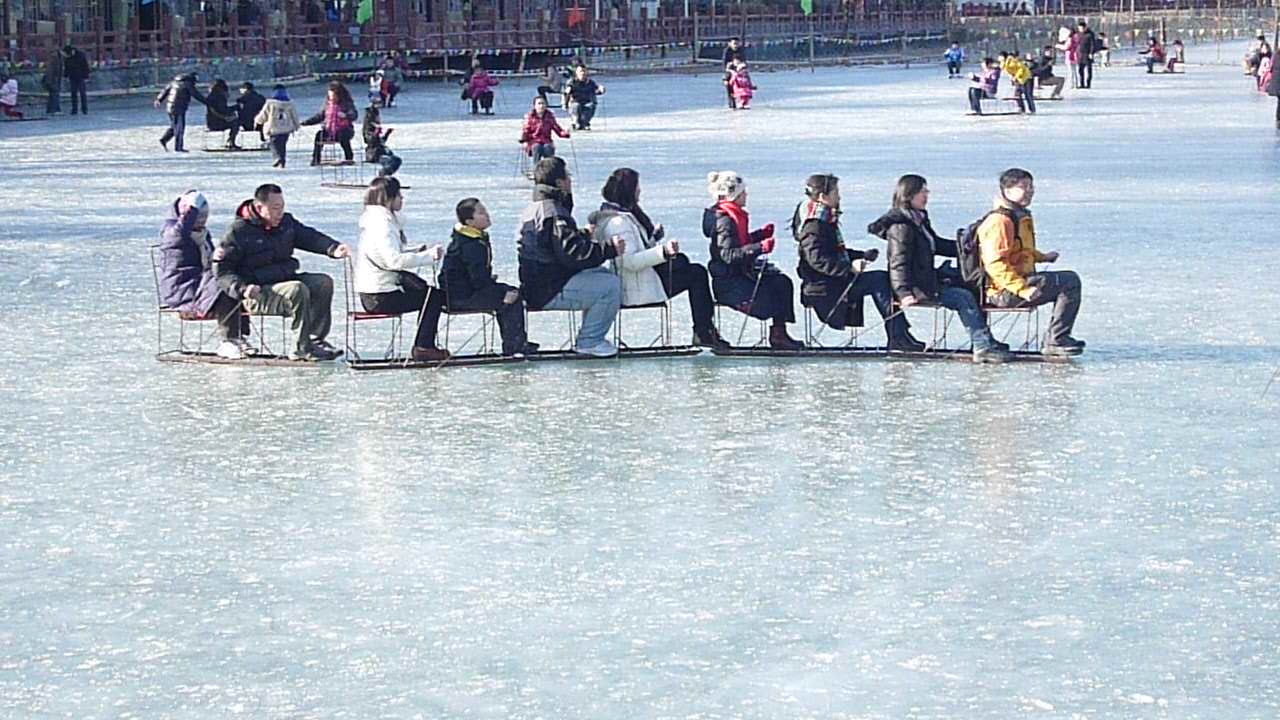
And now finally I come to the title of this post. In all my life I’ve never gone an entire winter without snow, but this year I came very close. Aside from a few flurries one day back in December, and a small snowstorm while I was in Korea that had all but melted by the time I returned, the Beijing sky was nearly cloudless from November to April. Millions of acres of crops failed this spring due to the lack of water, and this is a trend that has only been getting worse. Beijing is most likely seriously feeling the effects of ramped industrialization and the slow approach of climate change. It’s been a strange few months, and it gets even stranger in my next post about looking for an English teaching job…

A Chinese family enjoying the snowless winter with an ice-sled

Monday, January 17, 2011

“Whatever you can do or dream you can, begin it! For boldness has genius, power and magic.”

That’s a German saying that a friend once said to me when I was in a rut. It’s something I try to keep in mind whenever I find myself doubting whether I can do something, or when I’m unhappy with what I’m currently doing.

Last week I finished three intense weeks of working three jobs: a full time SAT tutoring job, and two freelance jobs, one helping a Chinese guy named Sam Wu to edit his business school applications, and another helping the China Energy Storage Alliance prepare a paper on US, European and Japanese energy storage policies.

So the question right now is, what’s next?


I’ve been told that I’m welcome back at the Research Center for Sustainable Development. I’ve also been tentatively offered a full time research job at the China Energy Storage Alliance. Both would be decent options to get some more experience in my chosen field…

But the funny thing that I realized recently is: I’m tired of sitting at a desk doing research. Yes, you might be thinking “it’s only been a little over seven months since you graduated Daniel – two of which were spent working at a “summer camp” in France – and you’re already tired of sitting in front of a desk? Bad news…” The other thing I realized though is that sitting at a desk doing research is not going to get me where I want to go either. So where do I want to go?

Sure, I still want to work in clean energy, but I also want to be an entrepreneur: I want to run my own business, be my own boss, and build new innovations that will change the world. I also want to become fluent in Chinese (duh, that’s why I came here…), travel around China and Southeast Asia, meet some interesting people and have new experiences. I recently came across this quote that just about sums it up:

“Twenty years from now you will be more disappointed by the things you didn't do than by the ones you did do. So throw off the bowlines. Sail away from the safe harbor. Catch the trade winds in your sails. Explore. Dream. Discover." ~ Mark Twain

Ironically, I came to China with the idea that I WAS NOT going to teach English. Everyone who comes here from the US and Europe comes to teach English, and I wanted to be different. But recently I began rethinking this. Teaching English, as well as some other subjects taught in English, are the highest paying jobs a recent graduate can find here by a long shot that don’t really require any specific skills or experience. Why shouldn’t I take advantage of my most marketable skill – being a native English speaker – to make some money, and spend that extra time and money I will save studying Chinese, having some fun experiences, and looking for new opportunities in the cleantech sector while I’m at it?

Another thing I realized about a year ago is that almost any clean energy business that’s worth starting requires at least a few million dollars in start-up capital. With relatively little business experience, there’s no way I’m going to attract that kind of capital right now. And being in a foreign country where energy is highly regulated and government connections are a necessity to start an energy business, this would be nearly impossible for me at this point.

However, one business I’ve thought about starting is importing Mongolian vodka to Beijing. Yes, Chinggis vodka, which I discovered during my trip to Mongolia, is not currently sold in Beijing. However, it has won international awards for its taste, and it won the five-vodka tasting contest I hosted at my friend’s apartment last month, easily beating name brands like Absolute and Sky. Considering the low selection of vodkas and the name recognition that Chinggis has begun to build within the foreign community here (I wasn’t the first to discover it on a visa trip to Mongolia), I think there might be a market for it. And I’m sure there are other opportunities out there as well.

So I started out with the idea that I was going to come here and find a clean energy job… and that somehow has evolved into teaching English and maybe starting my own business… You never know where life will take you, as long as you are willing to sail with the winds.

Fairwell, Niu Niu


I received some bad news shortly before Christmas. Niu niu, who was my “host father” when I was living in China last summer, passed away, at age 61. (Important Note: I created this blog with the intention of telling stories about my China experiences, so normally I wouldn’t mention things of such a person nature, but Niu niu was such a significant part of my China experience that it seemed appropriate). A few months ago the doctors discovered that he had cancer, and in November he had surgery to remove it. The surgery was successful and he had been home recovering. But he also had a heart condition, and died of a heart attack suddenly in early December.

Luckily I had the chance to see him one more time when I first returned to Beijing last September.  On a crisp fall day I traveled out to his apartment on the edge of the city, where sprawling apartments and the massive Capital Iron & Steel mill meet a small village at the foot of the mountains. Last summer I spent a lot of time hiking with Niu niu in those mountains, but since was not in any condition to be hiking now, I had to go that day alone. It was a beautiful day and the colossal view of the steel mill from the mountains was just as I remember it. As a result of these hikes, I wrote an article for an online news organization called GlobalPost last summer, about the water pollution and scarcity problems that I had observed, and that Niu niu had told me about. 


When I arrived at the bus station to meet Niu niu that evening, I could see right away that his health had deteriorated. We went to his apartment and had a good conversation, catching up on the past year. So far niu niu is the only person I’ve ever really gotten to know solely through communication in another language (he can speak about 5 words of English). Then we ate dinner with his wife and daughter, and his wife commented on how my Chinese had improved. This was encouraging, as I’d rarely heard her complement anybody.

As I was leaving, Niu niu told me to come and visit every once in a while, “yinwei women shi pengyou,” (because we are friends) was one of the last things I remember him saying to me.

In the two months that I lived with him, Niu niu taught me a lot about life in China, especially for the more rural, working class citizens that many foreigners rarely interact with. He was a good friend, and he will be sorely missed. 

Sunday, January 16, 2011

In my humble opinion, Mr. Chairman…

“…Well, I work for the Chinese government,” is my typical response these days when people ask what I do in Beijing. At the least this gets some raised eyebrows (I usually tell them I’m a ninja right after that), and it’s always a fun icebreaker. But these conversations usually don’t convey what a unique and eye opening experience working at the Chinese Academy of Social Sciences has been.

Like many of the other 10 million or so people working in this city, I’ve spent the last three months squishing into the subway or braving the chaotic roadways of Beijing during the morning and evening commutes. On the days I was feeling adventurous (and the weeks when I was living in an apartment that was close enough), I mounted a rickety, one speed bicycle and joined the fleet of other bicycles, electric bikes, scooters, motorcycles, cars, trucks and busses, honking and barreling their way through the crowded streets. There is no rhyme or reason to this mess, and very few traffic laws are obeyed – the winners in this giant game of chicken are usually the ones with the most guts and the biggest bumpers. Being on a bicycle put me second to last in the pecking order, just ahead of the pedestrians, so I had to be bold if I was going to get anywhere.

Rush hour in the subway
A few times during this commute, I would approach a major intersection with four to five lanes on either side of the road and line up with the rest of people, bikes and motorbikes. As this crowd grew and began to achieve a critical mass on both sides of the road, it would inch farther into the line of moving cars, which would begin to get narrower, speed up and start honking loudly in response – like a stream trying to squeeze through a narrow channel blocked by rocks on either side – daring one person to step into their path. Finally, a gap in the cars would emerge and the crowd would suddenly pour across the road – creating a solid barrier of people, bikes, motorcycles, and sometimes even horse drawn carts. The unlucky car that still had a green light would screech to a halt, honking in frustration. Somewhere in the cluster of people and vehicles, I would begin weaving my way to the front, narrowly avoiding hitting, or being hit by, other earnest commuters.

A few hundred meters after each intersection usually came another obstacle course: a bus stop. Whoever designed Beijing’s streets somehow overlooked the fact that the busses have to pull into the bike lane to pick up passengers. So as three or four busses would pull up to let on the throngs of passengers waiting at the bus stop, the bicycles were suddenly either forced out into open traffic, or had to try and squeeze between the bus and the passengers before the bus doors opened. At these times I felt like a tinny dingy trying to navigate between large ships in a congested harbor. I took some videos of this morning commute recently (this was challenging and a little dangerous, because it meant I only had one hand free to slam on the brakes or turn suddenly in traffic). I’ll be posting them on Youtube shortly with a link here.
Rush hour on the streets

Finally, after a good half hour of metropolitan madness, I would arrive at an ordinary office building in the heart of Beijing.

This office building however is home to an organization that many Chinese people dream of working for. The Chinese Academy of Social Sciences (CASS) is China’s most prestigious institution for social science (read: economic) research. CASS is one unit of the greater Chinese Academy of Sciences, and each unit is home to several different research institutes. While not a direct department of the government, one of my colleagues explained the relationship between CASS and the Chinese government by the location of the CASS building in relation to the rest of the city: In the old days, China was ruled by an emperor who lived in the Forbidden City, the palace that still sits at the center of Beijing. The Chinese believe in fung shui, an ancient spiritual art that puts great importance on the physical location of certain structures and aspects of a home or city in relation to the others. To this day, the land that sits on the same axis as the Forbidden City in Beijing is considered much more desirable, because of the positive fung shui it provides, and the closer to the palace, the better. Today, the main Chinese Academy of Social Sciences building is built on this axis, in the same location as the home of the ancient emperor’s economic & financial advisors.

Research Center for Sustainable Development office building
The Research Center for Sustainable Development is housed in a small building just to the north of this main building, and it is in this building that I came to be one of two foreigners working for CASS. By my third day on the job (when the whole institute went out for lunch together), everyone already seemed to know my name, even though I still hadn’t met most of the researchers there. Over the following weeks, I got to know many of my colleagues on the Climate Change Team over lunches – which were usually eaten in a cafeteria across the street – and also came to understand the hidden hierarchy that defines the relationship between each individual in my office. While nobody has a title except “PhD,” each person has a distinct rank, based mostly on seniority and perhaps a bit on expertise. I went out to lunch one day with the Institute’s Communist Party Secretary (every government outfit has one of these people to make sure everyone is following the party line), along with a guest of his and several other researchers. Everywhere we went, the Secretary and his guest would go through the door first – in fact they’d both insist that the other walk through first – and the other researchers would follow in order of “rank.”

The funny thing is that, as a foreigner, I can sense that many of my colleagues are unclear as to where I fit into this hierarchy. For example, I once caught a woman who is 30 years old and has a PhD referring to me in a way that implied we were equals, even though I was technically working on a project under her supervision at the time. While this in some ways puts me at an advantage and gives me more flexibility, this and the language barrier also create some limitations.

In fact, this is perhaps the first time in my life where I’ve sometimes felt that I was being discriminated against [After talking with a friend of mine, I realize this is not the best language to use. Everyone at CASS is very open minded, and I don't think any of them hold a prejudice against foreigners - I think I was letting some of my other experiences spill into the writing of this one]. This is not the fault of any of my colleagues in particular – they are all very nice to me – but I have twice now been excluded from meetings for the simple reason that I am a foreigner. Both involved discussions with high-level government officials that were considered somewhat sensitive – probably involved climate negotiation strategy or something. And maybe they had good reason, considering the WikiLeaks revelation that the US is using espionage to manipulate the climate change negotiations. But it still felt unnecessary – whatever they had to discuss probably wasn't that high level, considering some of my Chinese peers were allowed to attend.

So what have I actually been doing for these three months, you ask? Well, I spent the first month editing the English language version of a 200+ page book that the Center was publishing on a new proposal for the climate change negotiations. That was fun… (Not. Although, I did learn a lot about this specific proposal and I also learned some Chinese climate change vocabulary).

For the rest of the time though, I was doing some independent research on clean energy product trade between the US and China. This is a hot topic, because of the cleantech “trade war” that has been escalating between the US and China in recent months. Back in September, the United Steel Workers (the largest steel union in the US) filed a trade complaint to the US government, stating that China is unfairly subsidizing the production of cleantech and environmental goods, such as solar panels and wind turbines. Under rules that China agreed to abide by when it joined the World Trade Organization (WTO) back in 2002, countries are not allowed to subsidize domestic companies whose manufactured goods are mostly produced for export to other countries. In recent years, China has become the world leader in the production of solar panels and has made a major contribution to bringing down the cost of solar worldwide. However, this is partly because the Chinese government provides domestic solar manufacturers with many different forms of subsidies. In addition, 95% of the solar panels produced in China are exported to Europe and the US. Both Republicans and Democrats used this fact as significant political fodder during the last election (China bashing was about the only area in which the two parties seemed to agree). They claimed that China’s actions were costing the US “green jobs” and enlarging our trade deficit with China. As a result, the Obama administration agreed to go forward with the USW’s complaint and launch an investigation into China’s cleantech trade practices through the WTO. This action aroused much anger among leading politicians and academics in China (including some at the center in which I work). To them, this action seems very hypocritical on the part of the US government (and in some ways I have to agree).

So I set out to look at the trade data on clean energy products between the US, China and a number of other leading cleantech exporters (Germany, Japan, Denmark, India and Brazil to name a few). My goal was to find out whether China was in fact the biggest culprit when it comes to widening the US trade deficit in clean energy products. So I spent several weeks poring over data from the US International Trade Commission’s online DataWeb (this site is a pain – horrible user interface), analyzing the data and compiling it into charts and graphs. I then gave a presentation to my colleagues on my findings. Luckily they let me do it in English (my Chinese isn’t quite good enough for this yet), but I made the power point in Chinese, and we had some discussion in Chinese as well.

My main finding was that Japan and Denmark in fact were the two largest contributors to the US clean energy trade deficit (measured in terms of imports and exports of the two largest product categories: solar panels and wind turbine components), with China coming in third. India and Brazil were also significant contributors. My supervisor for this project (whose title would probably be something like Associate Director of the center if she had a title) seemed satisfied with my findings overall. In fact, since she is a fairly prominent party member, I like to think that my research might actually make its way to some of the higher-ups in the Chinese government. This got my imagination going, and at one point I had this amusing fantasy of suddenly being called into a meeting with the party Chairman and President of China, Hu Jintao, and being asked to give him a brief on my research…

In addition, as I mentioned a while back, I also participated in a public debate on the same subject at the Beijing Energy and Environmental Roundtable (BEER). This is a bi-weekly (or so) speaker series organized by the Beijing Energy Network, a group of about 1500 foreign and Chinese energy professionals working in Beijing. We had been asked to debate the notion that “China’s clean energy subsidies are fair, reasonable and justified.” There were two teams of three people each, and I was on the team debating against the notion, along with an Italian professor of geochemistry and a Chinese professor of environmental politics. Our opponents were the China economic correspondent for the Wall Street Journal, the Founder of a company called Dragonomics, and the Director of Climate Change for the British embassy. The debate was great fun, even though my team lost (having two non-native English speakers on the same team in an English language debate was maybe not the best idea, but I admired their courage none the less). I’ve since joined the Beijing Energy Network Organizing Committee, where I will be helping to plan speaker events and other initiatives (hmmm, kinda like Tufts Energy Forum…)

Thus ended my short stint working for the Chinese government. As the Christmas season approaches, I’m going to be taking on an SAT prep job with the Princeton Review for three weeks, as well as a few freelance jobs doing editing and clean energy research. With a short weekend visa run to Hong Kong in the middle for Christmas day, I’m going to be pretty busy this holiday season. Should keep my mind off the festivities I’ll be missing back in the US.

祝圣诞节和新年快乐!(Merry Christmas and Happy New Year!)

Saturday, December 18, 2010

Jumping Through More Hoops: The L-Visa Trip to Mongolia


Several weeks ago I went through one of the initiation ritual of being a foreigner living in Beijing. It was one of the strangest things I’ve ever done…

Many foreigners are living and working here on a tourist (L) visa, because work visas are notoriously hard to get unless you already have a job with a foreign company before you arrive. It’s relatively easy to get a tourist visa for up to a year, but with the stipulation that you have to leave the country every 30, 60 or 90 days, depending on the type of visa you get (mine is 60 days).  When you are working a full time job and don’t have much extra money, the cheapest and quickest way to do this is to travel a few hundred miles north to the border of China and Mongolia, cross over and come back.

Before leaving, I thoroughly researching what my fellow foreigners had done in the past on one of these trips. “Take a bus – it’s the most convenient and one of the cheapest ways to get to the border,” one of my friends had said. “Once you get there, you just have to find one of the jeeps that can take you across, as you aren’t allowed to go on foot. You just have to paying them – but I don’t remember how much.”

So late one afternoon, I boarded a long distance bus from Beijing to Inner Mongolia. These busses come fully equipped with three rows of bunk beds (something I never thought possible given width of a standard bus, but the Chinese managed to squish them in) for the 12-hour, overnight journey to the small border town of Erlian. We set out as the sun was setting and stopped for dinner a few hours later near a large power plant on the edge of Inner Mongolia, one of China’s largest and most desolate provinces. As I climb out of the bus into the freezing night, I saw a giant cooling tower framed against a vividly starry sky – the first stars I’d seen since entering China two months earlier.

That night I didn’t get much sleep. Just as I saw starting to doze off in my tiny top bunk, the bus must have started going through some mountains, because we were suddenly twisting and turning all over the place. Between motion sickness and feeling as though I was going to fall out of my bed every time we went around a corner, I only managed to doze for a few hours. When I woke the next morning, I looked out the window to see the sun just beginning to rise over the endless, flat grassland of Inner Mongolia. Arriving in Erlian around 7am, everyone disembarked and immediately began pilling into several pick-up trucks parked around the bus. Many of my companions on the bus did not seem to speak any Mandarin, so I assumed most of them were from Mongolia and had arrived here to cross over the border as well. I went up to one of the drivers and asked him in English if he was going to Mongolia. “Ah, Mongolia!” He replied in a thick accent and nodded his head enthusiastically. “The jeeps will be pretty obvious when you arrive – you can’t miss them,” one of my friends had said before I left. Confused, tired and thinking that maybe my friend had really meant trucks instead of jeeps, I pilled into the back of the pickup along with three other passengers and a load of cargo.

The trucks parked at the bus station
After dropping our companions off at various places in town (this should have given me a clue), the driver set out for the border gate. But when we arrived he stopped before the gate and said “Mongolia! 100 kuai!” I had broken two of the cardinal rules of getting around in China: Never trust an overly enthusiastic Chinese man, and always clarify/ negotiate a price before getting into a car. In protest, I began saying in mandarin that he was “cheating me,” and discovered that this man also spoke some mandarin. I managed to negotiate the price down to 25 kuai, although this was still too expensive (the “fair” price for crossing the border as I found out later is about 30, and the price of traveling across town should be about 5). It was now about 7:30, but the gate didn’t open until 8:30. So I walked back toward town to see if I could find somewhere to eat. After about 20 minutes of walking through the almost deserted down, I realized that it would take me hours to find food at this rate. A man was park on the opposite side of the road watching me, so I over to ask him where I could get some food and where I could find one of these jeeps.

The man turned out to be a local taxi driver, and he knew a number of places I could get food. He also offered to help me stop one of the jeeps that would be coming through shortly. Just then one of these jeeps started coming down the road. We stopped the driver and my new friend had a brief conversation with him in Mongolian. Then he said to me in Mandarin that it would be 60 kuai. Something told me that this was too high, so I tried to negotiate, but he just shook his head and prepared to drive away. “This is the best price you will get,” my taxi driver friend said. I tried one more time to bring the price down, but the jeep driver wouldn’t have it. Finally I started to walk away, a common tactic that usually gets Chinese people to call you back and bring their price down. But this driver just drove away – a good sign that his price had in fact been the fair one. “I told you, that is the lowest price they will offer,” my new friend said. “Usually their price is higher, but I can help you get a discount.” Feeling silly, I apologized and told the taxi driver that I would appreciate his help getting the next one. Then I asked him to take me into town to find some food. As we drove I had a nice conversation with the taxi driver. He seemed as though he really just wanted to help me. I started to let my guard down.

We pulled into a parking lot, next to several small, hole-in-the-wall type restaurants. The taxi driver told me I could leave my duffle back in his car, and led me toward the nearest restaurant. We soon learned that it was closed, and move on to the next one. Finally we found one that was open, and I ordered a breakfast of generic, white buns with meat in them and some kind of Mongolian milk tea. “Take your time eating,” the taxi driver said, “I’m going to go move the car closer.” I sat at a table, watching him walk out of the restaurant and across the parking lot. Then with a sudden jolt, my complacency disappeared and alarm set in…

How could I have been so stupid? Although he didn’t know what was in it, my duffle bag was sitting in his car with my ipod, camera, and about 1000 RMB in cash. He could easily drive off with my bag and I wouldn’t have the slightest idea how to ever find him again. I jumped up and ran out into the parking lot, just as he was starting to drive in my direction (the exit to the parking lot was also in the same direction though). But it turned out I had nothing to worry about. As he drove up and parked in front of the restaurant, he looked at me quizzically, and I made up the excuse that I’d forgotten my hand sanitizer to clean my hands before eating. As I rummaged around in my bag pretending to look for it, I grabbed my valuables and buried them in my coat pocket.

Returning to the roadside near the border gate, the taxi driver helped me to stop another jeep (this one packed to the bursting point with cargo), and “negotiated” another 60 kuai deal for me. I took out the money to give to the jeep driver, but instead the taxi driver accepted it and directed me to squeeze into the front seat (the jeep had so much cargo that the seat itself was already pushed all the way forward, with the head resting against the glass of the front windshield). As I climbed in I notice out of the corner of my eye that the taxi driver and jeep driver were quietly exchanging something.

We arrived at the border gate, where the driver stopped and began arguing with some Chinese people waiting nearby, who looked like they also were looking for a ride. Finally he agreed to let one Chinese guy also climb into his jeep for the ride across. I was a little annoyed, as my head was already pressed against the glass and I had barely enough room to wiggle my toes. But as this guy climbed in, I noticed he was dressed much more cosmopolitan than most of the others. “Do you speak English?” I asked him. “Of course,” he replied in an American accent. “I’m from Austin, Texas. My name’s Frank.”

It was a relief that I had finally found another foreigner going through this crazy ritual. And what’s more, he had already done it nine times. As we drove across the border, he told me about how all the taxi drivers and jeep drivers were in on this whole scam together – how my taxi driver “friend” probably got a cut of the 60 kuai for convincing me that it was the market price – as well as many other details from his past experiences. Within 30 minutes we had gone through the two border gates, gotten the stamps we needed on our passports to prove that we’d left the country, and arrived in the open grasslands of real (outer) Mongolia. And then we turned around and went back through into China. I was in Mongolia for about 10 minutes.

Driving back to Beijing in the van - there's apparently a dinosaur museum in Erlian, so they had these dinosaur statues to advertise it. As you can see, there's not much else for hundreds of miles.

When we came through the gate on the other side, there were some vans waiting that Frank said could take us back to Beijing for about the same price as the bus, but we would leave in the afternoon and get back that night. We asked the driver to pick us up in town around 2pm, and set out to go explore the bustling border town of Erlian. After about 20 minutes of walking down the main street we were already bored, but I had one last mission in mind for my trip to Mongolia: bring back some Mongolian vodka that I’d heard about, called Chinggis (native spelling of Genghis). My friend had told me you can get this stuff in Erlian for less than $10 a bottle, and the quality is about the same as some of the high-end brands you’d find in the US (it’s much better than Absolute, for example). I went into a few shops that were selling it, and eventually negotiated a good deal for eight bottles, which I planned to sell to people in Beijing when I got back.

A few hours later, Frank and I piled into the van, and started heading for Beijing at top speed. We arrived back around 10pm, and the driver dropped me at my apartment. Feeling very car sick (getting back in eight hours meant this guy was speeding everywhere) and hungry, I was glad to be back in Beijing (in time for Halloween the next night), having successfully completed my first ritual visa trip.